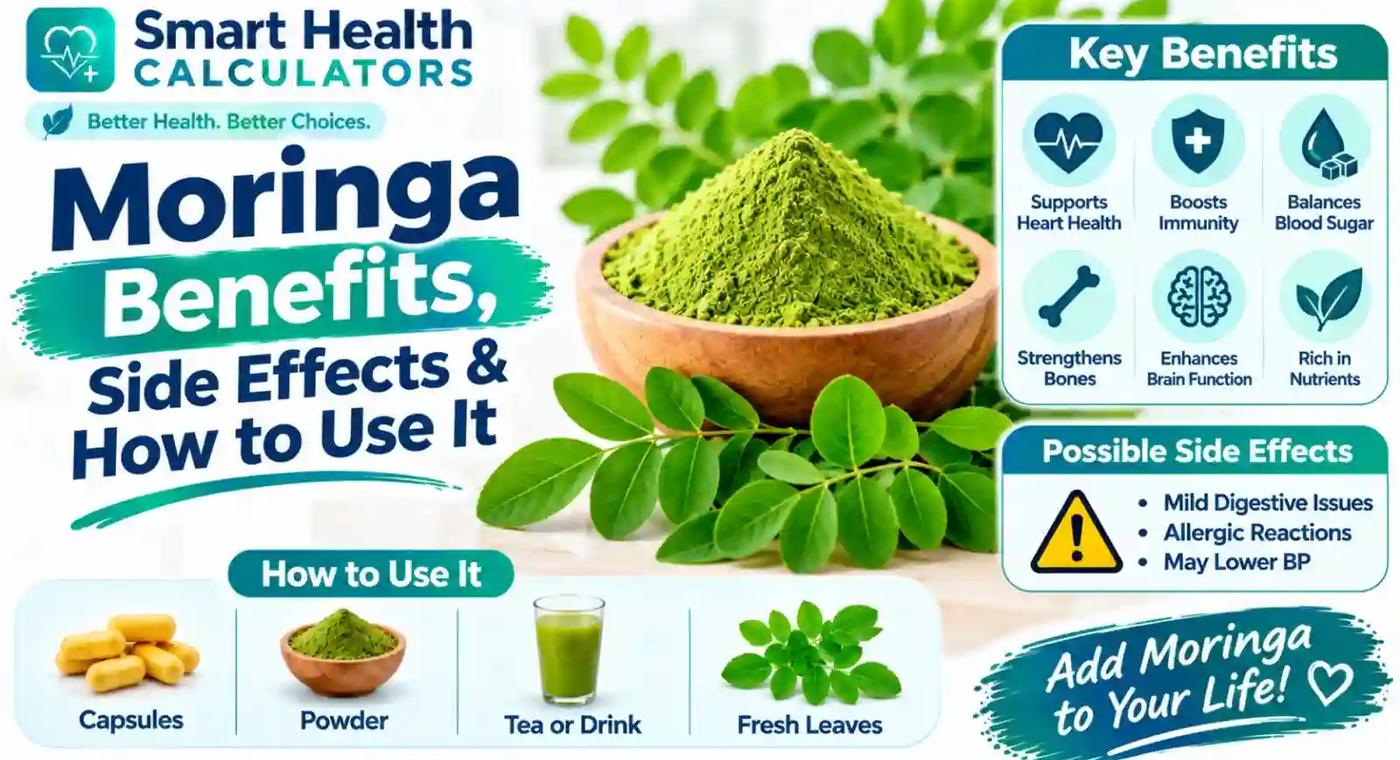
Moringa Benefits, Side Effects & How to Use It (2026)
Moringa benefits, side effects and how to use it safely. See what research really shows, who should avoid it, and how to take powder or tea.
Moringa (Moringa oleifera) is a nutrient-rich plant whose leaves are eaten as food and sold as powder, tea and capsules. As a food, it's generally considered fine for most healthy adults. As a health treatment, the evidence is thin. A 2025 meta-analysis of randomized trials found no consistent benefits for blood sugar, cholesterol or weight, and rated the evidence "very low" certainty. Possible side effects include stomach upset and, rarely, allergic reactions. Pregnant or breastfeeding women and anyone taking medication should talk to a clinician first.
- Moringa leaves are a nutritious food. That is the best-supported claim.
- Human evidence for treating diabetes, high cholesterol, high blood pressure or obesity is limited and inconsistent.
- There is no established medical dose. Trials used very different amounts.
- Roots and bark are not eaten as food. Stick to leaves and seeds, and be cautious with concentrated supplements.
- Supplements aren't approved by the FDA before they're sold, so product quality varies.
Walk into any health-food shop and you'll find moringa: green powder in a pouch, capsules in a bottle, tea bags with "superfood" on the front. The claims can be dramatic. It's said to balance blood sugar, melt weight, boost energy and fix your skin.
The reality is more modest and more interesting. Moringa really is a nutritious plant with a long history of use as food and folk medicine. But "nutritious" and "proven treatment" are different things. This guide separates the two. You'll see what moringa contains, what research does and doesn't show, who should be careful, and how to use it sensibly if you decide to try it.
What Is Moringa (Moringa oleifera)?
Moringa oleifera is a fast-growing tree native to parts of South Asia. It's also known as the drumstick tree (after its long seed pods), the horseradish tree and the "miracle tree." In Pakistan and India it is widely known as sohanjna or sahjan, and the leaves, flowers and pods are used in home cooking.
Which Parts of the Plant Are Used?
Different parts are used differently, and that matters for safety:
- Leaves: The most common part. Eaten fresh, cooked, dried or ground into powder.
- Pods ("drumsticks"): Cooked in curries and soups. The fibrous outer layer is usually removed.
- Seeds: Eaten in some traditions.
- Flowers: Used in cooking and teas in some regions.
- Roots and bark: Used in folk remedies, but not typical foods. Cleveland Clinic advises that roots, bark and flowers are not safe to eat.
Memorial Sloan Kettering Cancer Center (MSK) notes that the leaves and seeds are nutritious foods, and that it is generally considered safe to eat the leaves and seeds and to drink the powder mixed in liquid. If you're new to the plant, leaves are the sensible starting point.
Moringa Nutrition Facts: What's Actually in It?
Moringa leaves are often compared to spinach, and the comparison is fair. Cleveland Clinic, citing USDA figures, lists these amounts for one cup of chopped leaves: about 13 calories, 2 g protein, 0.5 g fiber, 39 mg calcium, 79 mcg vitamin A, 11 mg vitamin C and 1 mg iron. For 100 g of boiled pods, it lists about 36 calories, 2.1 g protein, 4.2 g fiber, 457 mg potassium and 97 mg vitamin C.
Those figures describe whole fresh food. Two cautions will keep you grounded:
- Powder isn't the same as fresh leaves. A teaspoon of powder is a small amount of dried leaf, so the nutrients you get are modest. Check labels, and look up specific foods in USDA FoodData Central for official nutrient data.
- Online "90+ nutrients" claims are marketing. The presence of a nutrient in a leaf doesn't mean a typical serving supplies a meaningful share of your daily needs.
Protein, Fiber and Antioxidant Compounds
Moringa contains plant protein, fiber and a range of plant compounds, including polyphenols and flavonoids such as quercetin and chlorogenic acid. These have antioxidant activity in the lab. But a compound that works in a test tube doesn't automatically do the same in your body. If protein is your goal, a spoonful of leaf powder won't move the needle much. See our guide to the most protein-rich foods and how much protein you need per day. For fiber, compare with these high-fiber foods.
Potential Health Benefits of Moringa: What Does the Research Say?
Here's the honest scorecard. We've graded each area by how much human evidence we found in the sources we reviewed.
| Area | Human evidence | Bottom line |
|---|---|---|
| General nutrition | Strong (it’s a food) | Nutritious leafy green |
| Blood sugar | Limited, inconsistent | Not a replacement for treatment |
| Cholesterol | Preliminary | Not established |
| Blood pressure | Mixed, low certainty | Not proven to treat hypertension |
| Weight management | No consistent effect | Don’t expect weight loss |
| Inflammation, antioxidants | Mostly lab research | Promising, unproven in people |
| Skin and hair | Little reliable human data | Unproven |
What the Best Evidence Shows
The strongest summary is a 2025 meta-analysis in Nutrients: Effects of Moringa oleifera Lam. Supplementation on Cardiometabolic Outcomes. It pooled nine randomized controlled trials covering 341 people in the intervention groups and 308 in the control groups. Its main findings:
- No significant effect on body weight, BMI or waist circumference.
- No significant effect on fasting blood glucose or on HbA1c, a longer-term blood sugar marker.
- No significant effects on triglycerides, total cholesterol, LDL or HDL.
- Blood pressure: no significant change in systolic pressure, and a small reduction in diastolic pressure that the authors said was "not robust" in sensitivity checks.
- Certainty of evidence: very low for every outcome.
The authors concluded that the evidence "does not support consistent cardiometabolic benefits" and advised against using moringa as a standalone cardiometabolic therapy. They also flagged problems with the underlying trials, including small sizes, differing preparations and doses, and weak reporting.
A 2026 meta-analysis in Food Science & Nutrition (Samarin et al.) looked at blood pressure and body weight. It is reported to have found pooled blood pressure reductions but no significant change in weight or BMI. We could not open the full text, so check it yourself before relying on the details. Either way, these results don't prove that moringa treats high blood pressure.
MSK's summary lines up with this. It says studies in humans are "quite limited," with a small preliminary effect on lipids, and calls for well-designed studies in people with diabetes or prediabetes.
Is Moringa Good for Blood Sugar?
Maybe a little, maybe not. Lab and animal studies suggest effects on glucose, but human trials haven't shown consistent benefits. If you have diabetes, moringa should never replace your medication. Because it might lower blood sugar, it could add to the effect of diabetes drugs, so check with your clinician.
Is Moringa Good for Weight Loss?
The 2025 meta-analysis found no significant effect on body weight or BMI. One case report described skin toxicity after someone used moringa powder for weight loss (more on that below). Weight management still comes down to the basics. Our weight loss strategies, the calorie intake planner and the BMI calculator are better places to start. For a look at tea claims in general, see teas that may help with weight loss.
Skin, Hair and "Detox"
You'll see moringa promoted for glowing skin, hair growth and liver "cleansing." We didn't find solid human trials supporting these claims in the sources we reviewed. MSK says moringa "has other uses, but doctors haven't studied them to see if they work." And "detox" isn't a clinically established effect of any leaf powder. Your liver and kidneys already do that job.
Moringa Benefits for Men and Women
Search results love gender-specific claims. The honest version is that the main benefits don't differ by sex.
For both: A nutritious leafy green may add vitamins, minerals and fiber to a meal. That's the realistic upside.
For women: Some women try moringa for iron or general nutrition. Iron content in a small powder serving is limited, and anyone with suspected iron deficiency should get tested and treated properly. Pregnancy and breastfeeding need special caution (see below).
For men: Claims about testosterone or stamina are mostly marketing. We found no reliable human evidence for them in our sources.
If you're building a balanced eating plan, our diet plan generator and guides to the whole foods diet and the DASH diet offer more reliable footing than any single plant.
Moringa Side Effects and Risks
At normal food amounts, moringa tends to be well tolerated. Cleveland Clinic notes few risks at food amounts, but overeating may cause stomach cramps, diarrhea, gas or nausea. Don't assume "natural" means "risk-free," especially with concentrated products.
Common and Mild Effects
- Upset stomach or cramps
- Loose stools or diarrhea
- Gas or bloating
- Nausea
These are most likely if you jump in with a large amount. Starting small helps.
Rare but Serious Reactions
MSK's clinical section describes case reports of serious reactions, including Stevens-Johnson syndrome, cutaneous toxicity (after moringa powder for weight loss) and anaphylaxis with angioedema. These are case reports, not common outcomes, and not everyone will experience them. But if you develop a rash, swelling of the face or throat, or difficulty breathing, stop and get urgent medical help.
Medication Interactions
Interactions are an area of real uncertainty. MSK reports preclinical (lab and animal) data suggesting moringa may inhibit the CYP3A4 enzyme and increase the bioavailability of rifampin, and that long-term use reduced the effect of the diabetes drug sitagliptin in an animal model. It states that the clinical relevance of these findings has yet to be determined. Moringa may also lower blood glucose.
Cleveland Clinic advises talking to a provider before making moringa a staple if you take blood thinners, blood pressure medicines, statins, diabetes medicines, thyroid medicines or drugs processed by the liver. We can't predict your specific interaction, so ask a pharmacist or doctor. If you manage blood pressure, see our guides on high blood pressure, lowering it naturally and low blood pressure.
Who Should Avoid Moringa or Check First?
- Pregnant or breastfeeding women. MSK's professional section says pregnant and breastfeeding women should avoid moringa, and its patient section advises talking with a provider first. Our staying healthy during pregnancy guide covers safer nutrition basics.
- People on prescription medication, especially for diabetes, blood pressure, cholesterol, thyroid conditions or anything processed by the liver.
- Anyone with a history of allergic reactions to plants or supplements.
- Children. We didn't find solid guidance on safe supplement amounts for children, so ask a pediatrician.
- Anyone about to have surgery, since supplements can affect blood sugar or interact with medicines. Tell your care team.
How to Use Moringa: Powder, Leaves, Tea and Capsules
Moringa Leaf Powder
Powder is the easiest form to find and use. Cleveland Clinic describes the taste as "a bit grassier," similar to matcha. Practical ways to use it:
- Stir a small amount into a smoothie with banana or mango to mask the grassiness.
- Mix into yogurt, oatmeal or soup.
- Add to dal, curry or chapati dough.
- Whisk into warm (not boiling) water.
Tip from real-world use: Start with a small pinch or a quarter teaspoon for a few days. If your stomach is fine, you can nudge it up. Powder clumps, so blend or whisk it.
Fresh or Cooked Leaves
Fresh leaves are bitter and peppery. Cleveland Clinic says they're sharper than arugula. Cook them like spinach, in stir-fries, curries, eggs or lentils. This form gives you the most "food-like" experience and tends to be the gentlest approach. If you're in South Asia, you may already find leaves and pods at the local market.
Moringa Tea
Moringa tea is simply leaves or powder steeped in hot water.
- Use a small amount of dried leaf or about a quarter teaspoon of powder.
- Pour hot (not boiling) water over it.
- Steep for several minutes, then strain if you used leaves.
- Add lemon or honey if you like.
Tea is a mild way to try moringa, but it isn't proven to deliver specific health effects. For other drink ideas with better evidence behind them, see the best drinks for heart health.
Capsules and Extracts
Capsules are convenient and avoid the taste. They can also pack concentrated amounts. Compared with powder, capsules make it harder to judge how much plant material you're getting, and quality varies by brand. For anyone with a medical condition, concentrated products deserve extra caution. For another look at how supplements are judged, see our post on brain health supplements and magnesium glycinate dosage.
Best Time to Take It
There's no proven "best time." Some people prefer it with food to reduce stomach upset. If it affects your sleep or digestion, adjust the timing. Consistency matters more than the clock.
Moringa Dosage: What Does Research Say?
This is the part many articles skip: there is no established medical dose for moringa. MSK's publicly available text gives no dosage, and trials have used widely varying preparations, doses and durations. The 2025 meta-analysis noted variable formulations (leaf powder, steamed leaves, polyherbal mixes) and doses. Its exploratory subgroup analysis suggested possible benefits at under 10 g per day, but the authors treated that as tentative.
What does that mean for you?
- Don't chase a number. There's no proven therapeutic dose to hit.
- Follow the product label, and don't exceed it.
- Start low. Many people begin with a small amount, such as a quarter to half teaspoon of powder, to see how their digestion reacts. That's a practical starting point, not a medical prescription.
- Cleveland Clinic's advice: consistency matters more than volume, and don't down cup after cup.
- Ask a professional if you have a health condition or take medication.
Is It Safe to Take Daily?
For most healthy adults, small food-level amounts are likely fine. But long-term safety data for concentrated supplements is limited, and we can't promise safety for everyone. If you take it daily for months, check in with your clinician, especially if you start new medicines.
How to Choose a Quality Moringa Product
The FDA says it doesn't have the authority to approve dietary supplements before they're marketed. Under the Dietary Supplement Health and Education Act of 1994, firms are responsible for ensuring their supplements aren't adulterated, for substantiating claims and for following good manufacturing practices. In practice, that means you shoulder some of the burden. See the FDA's Questions and Answers on Dietary Supplements.
A Simple Buying Checklist
- Check the ingredient list. Pure moringa leaf powder should list just that, with no fillers.
- Identify the plant part. Leaf is the usual choice. Avoid products that don't say.
- Look for independent testing, such as a third-party seal or a lab report, for contaminants and label accuracy.
- Be skeptical of miracle claims. Phrases like "cures," "detoxes" or "melts fat" are red flags.
- Check the dose and serving size, and compare price per gram, not just per pouch.
- Read the warnings, especially for pregnancy and medication.
If something goes wrong, the FDA encourages consumers and providers to report problems through its Safety Reporting Portal.
How to Store Moringa Powder
Keep it in an airtight container, away from heat, light and moisture. Close the pouch tightly after each use, and discard it if it smells off, clumps from moisture or shows mold.
Moringa vs Other Superfoods
Comparison searches are popular, but most "versus" claims are shaky. A fair way to think about it:
| Comparison | What to know |
|---|---|
| Moringa vs spinach | Both are leafy greens. Cleveland Clinic compares moringa leaves to spinach. Neither is a cure-all |
| Moringa vs matcha | Powder texture and grassy taste are similar. They’re different plants with different compounds |
| Moringa vs spirulina | Different organisms (a tree leaf vs an algae). Nutrient profiles differ |
| Moringa vs a multivitamin | A multivitamin has standardized doses. Moringa powder doesn’t |
| Powder vs capsules | Powder is flexible and food-friendly. Capsules are convenient but harder to judge |
The takeaway: no single powder replaces a varied diet. Moringa can be one ingredient among many, not a shortcut.
Moringa in Pakistan and South Asia: A Local Note
If you live in Pakistan, India or Bangladesh, moringa isn't exotic. The leaves, pods and flowers are common in home cooking, which is arguably the best way to use it. Cooked as food, you get the leaves in realistic amounts alongside other ingredients. For powders and capsules sold online or in stores, apply the same checklist above, because quality and labeling vary by seller. We haven't verified local pricing or brand quality, so we don't recommend specific products.
Practical Tips: Using Moringa Wisely
- Treat it as food first. Cook the leaves, add powder to meals and keep portions modest.
- Don't self-treat. Never swap moringa for diabetes, blood pressure or cholesterol medication.
- Tell your clinician if you take it regularly, especially alongside prescriptions.
- Watch your body. Stop and seek care if you notice a rash, swelling or breathing trouble.
- Judge by results you can measure. If you're tracking blood sugar or blood pressure, keep tracking. Don't assume moringa is doing the work.
- Pair it with basics. Sleep, movement and balanced meals do far more than any powder. Use our water intake calculator and the body fat estimator to check in on habits and progress.
Why Choose Smart Health Calculators?
Supplement information is full of hype, so we try to do the opposite: name the source, state the evidence level and say plainly when something is unproven. Why choose Smart Health Calculators? Because we pair readable guides with practical tools, and we'd rather tell you a claim is unsupported than sell you a dream. Browse our health calculators and the free diet plan generator guide for next steps.
Smart Health Calculators provides general information and does not replace advice from a doctor, pharmacist or dietitian.
Frequently Asked Questions
What is moringa and where does it come from?
Moringa is the common name for Moringa oleifera, a tree native to parts of South Asia. Its leaves, pods and seeds are eaten, and the leaves are sold as powder, tea and capsules.
What are the main benefits of moringa?
It's a nutritious leafy green. Claims about treating diabetes, cholesterol, blood pressure or weight are not well supported by human trials, and a 2025 meta-analysis rated the evidence very low certainty.
Is it safe to take moringa every day?
Small food-level amounts are likely fine for most healthy adults, but long-term safety data for concentrated supplements is limited. Talk to a clinician if you have a health condition or take medication.
Can moringa cause side effects?
Yes. Stomach cramps, diarrhea, gas and nausea are possible, especially with large amounts. Rare serious reactions, including allergic reactions, have been reported in case studies.
Can pregnant or breastfeeding women take moringa?
MSK's professional section says pregnant and breastfeeding women should avoid moringa. Always check with your obstetrician or provider first.
Does moringa interact with medications?
It might. Lab data suggest effects on a liver enzyme (CYP3A4), and it may lower blood sugar. The clinical relevance isn't established, so ask your pharmacist or doctor, especially if you take diabetes, blood pressure or blood-thinning medicines.
Can moringa help with weight loss or blood sugar?
The 2025 meta-analysis found no significant effect on body weight, BMI, fasting glucose or HbA1c. It shouldn't replace diabetes treatment.
Is moringa better as powder or capsules?
Neither is proven better. Powder is flexible and food-friendly, while capsules are convenient but concentrated and harder to judge. Whichever you choose, check quality and follow the label.
Conclusion:
Moringa deserves its place as a healthy leafy green. It doesn't deserve the "miracle tree" reputation. Human research hasn't shown reliable benefits for blood sugar, cholesterol or weight, the evidence is rated very low certainty, and concentrated supplements carry real unknowns around interactions and pregnancy. Use it as food, start small, buy carefully and keep your clinician in the loop.
For a sensible next step, set a baseline for your own habits: check your hydration with the water intake calculator, then plan your meals with the diet plan generator. When you're ready for more, Explore Advanced Tools at Smart Health Calculators.
Medical Disclaimer
This article is for general education only. It is not medical advice, diagnosis, treatment, prescription guidance, or a replacement for professional healthcare. Speak with a qualified healthcare professional for personal medical concerns, symptoms, pregnancy concerns, mental health crisis, medication questions, or before making major health changes.