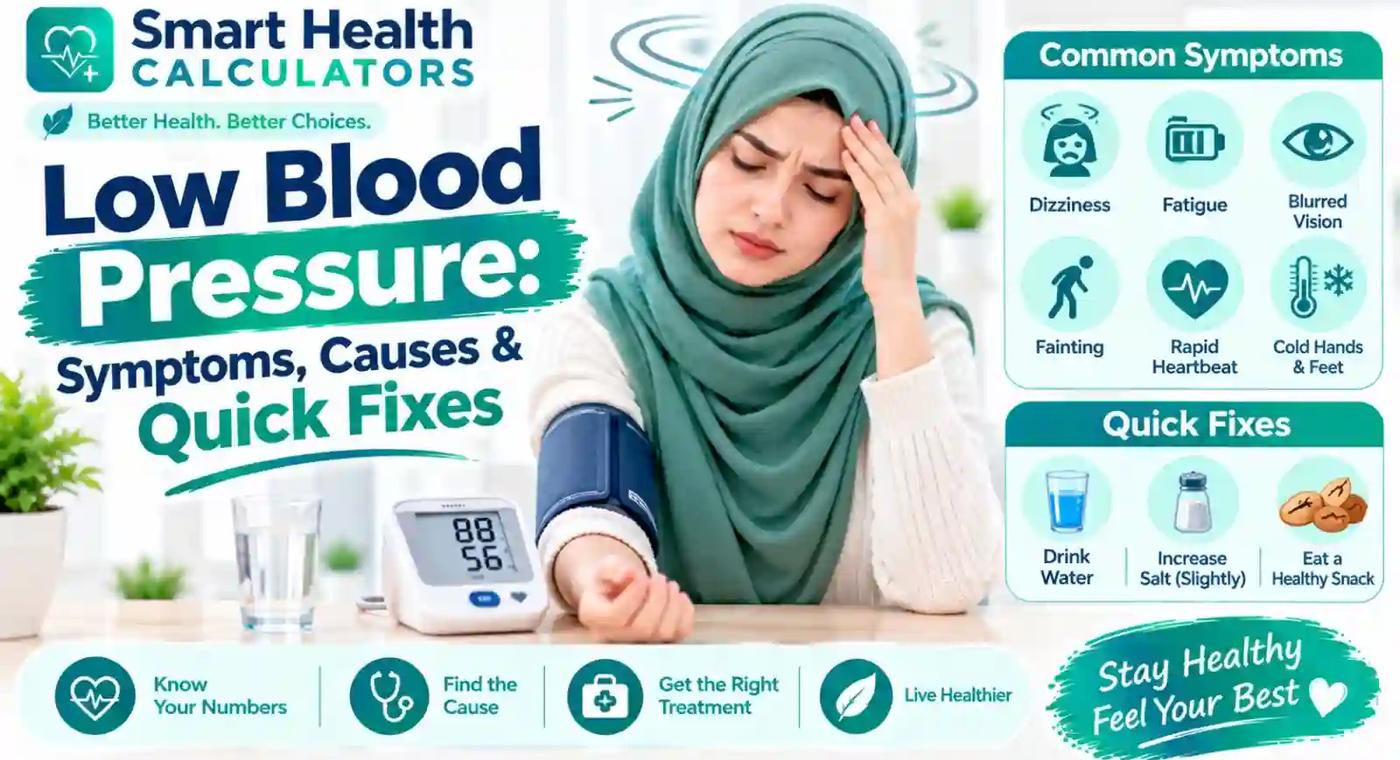
Low Blood Pressure: Symptoms, Causes & What to Do Right Now
Is 90/60 too low? Learn the symptoms and causes of low blood pressure, safe steps when you feel faint, and the warning signs that need emergency care.
This guide explains what counts as low blood pressure, which symptoms matter, what causes it, and what you can do in the moment. It also draws a firm line between "sit down and sip water" and "call emergency services now." One caution up front: low blood pressure has many causes, and the right response depends on the cause, so nothing here replaces advice from your own clinician.
Low blood pressure (hypotension) is generally a reading below 90/60 mmHg. It's only a medical concern if it causes symptoms such as dizziness, fainting, blurred vision, or weakness, or if it drops suddenly. If you feel faint, sit or lie down right away and stand up slowly later. Seek emergency care for collapse, chest pain, confusion, cold clammy skin, rapid shallow breathing, or a weak, rapid pulse.
What Is Low Blood Pressure?
Blood pressure is the force of blood pushing against your artery walls. It's written as two numbers in millimeters of mercury (mmHg):
- Systolic (top number): pressure when your heart beats
- Diastolic (bottom number): pressure when your heart rests between beats
The National Heart, Lung, and Blood Institute (NHLBI) and Mayo Clinic both describe low blood pressure as a reading lower than 90/60 mmHg. Either number being low can count.
Normal vs low: a quick comparison
| Category | Typical reading (adults) |
|---|---|
| Low blood pressure | Below 90/60 mmHg |
| Typical normal range | Roughly 90/60 up to below 120/80 mmHg |
| Elevated or high | 120/80 and above (see a clinician for classification) |
Is low blood pressure always a problem?
No. This is the single most important point in the whole topic.
Some people, especially younger, fit, or slim people, run low readings their entire lives and feel completely fine. The NHLBI notes that hypotension is a medical concern only if it causes signs or symptoms. The American Heart Association says much the same: doctors generally consider chronic low blood pressure dangerous only when it causes symptoms. The AHA's page on low blood pressure explains this in plain language.
What matters is also how fast your pressure falls. Mayo Clinic notes that a drop of just 20 mmHg, for example from 110 to 90 systolic, can be enough to make you feel dizzy or faint.
Symptoms of Low Blood Pressure
When pressure is too low to push enough blood to the brain and other organs, you may notice:
- Dizziness or lightheadedness, especially when standing
- Blurred, dimming, or "fading" vision
- Fainting (syncope) or feeling like you're about to faint (presyncope)
- Weakness or fatigue
- Nausea or an upset stomach
- Trouble concentrating
- Cold, pale skin in some cases
- Rapid heartbeat as the body tries to compensate
Many of these symptoms overlap with other conditions, including anemia, anxiety, inner-ear problems, low blood sugar, and arrhythmias. A low reading that matches your symptoms makes hypotension more likely, but it's not proof on its own.
Dizziness vs vertigo
These get mixed up, and the difference helps your clinician.
| Feeling | What it usually means |
|---|---|
| Lightheaded, “about to faint” | Often related to blood flow or blood pressure |
| Vertigo (the room spins) | More often related to the inner ear or balance system |
If the room is spinning rather than greying out, low blood pressure is less likely to be the main cause.
Types of Low Blood Pressure
Mayo Clinic describes several types. Knowing which one fits your pattern helps you prevent episodes.
Orthostatic (postural) hypotension
Blood pressure drops when you stand up after sitting or lying down. A commonly used clinical criterion is a sustained fall of at least 20 mmHg systolic or 10 mmHg diastolic within 3 minutes of standing. It's common in older adults, and causes include dehydration, long bed rest, pregnancy, certain medicines, and some medical conditions.
Postprandial hypotension
Blood pressure falls after eating, usually within an hour or two. It mainly affects adults older than 65. Mayo Clinic suggests that eating small, low-carbohydrate meals, drinking more water, and avoiding alcohol might help.
Neurally mediated hypotension (including vasovagal)
A drop that happens after standing for a long time, or when you're emotionally stressed, in pain, or see blood. This type mainly affects children and younger adults.
Severe hypotension linked to shock
A sudden, severe fall that deprives organs of blood. This is an emergency (see below).
Common Causes of Low Blood Pressure
Causes range from everyday to serious. A few themes come up again and again.
Fluid and volume loss
- Dehydration. Not drinking enough, or losing fluid through vomiting, diarrhea, fever, sweating, or heat exposure, reduces blood volume. Our guides on signs you're not drinking enough water, how much water to drink in extreme heat, and what hydration really means cover this side.
- Blood loss. Injuries or internal bleeding can drop pressure severely.
Medicines
Mayo Clinic lists several medicine groups that can lower blood pressure:
- Medicines that treat high blood pressure, such as diuretics, alpha blockers, and beta blockers
- Some heart medicines
- Certain antidepressants and other drugs
- Medicines for Parkinson's disease and erectile dysfunction
Never stop or change a prescribed medicine on your own. Call your prescriber or pharmacist instead.
Medical conditions
- Heart problems, such as heart failure, very slow heart rate (bradycardia), or arrhythmias
- Endocrine conditions, including thyroid disorders and adrenal insufficiency
- Diabetes, which can affect the nerves that regulate blood pressure
- Autonomic nervous system disorders, including Parkinson's disease
- Nutrient deficiencies, such as low iron or B12 leading to anemia
- Severe infection (sepsis), which can cause a dangerous drop
- Severe allergic reaction (anaphylaxis), which causes a sudden, large drop
Life stages and situations
- Pregnancy. Blood vessels widen quickly, which can lower pressure. Mayo Clinic notes low blood pressure is common in the first 24 weeks of pregnancy.
- Older age. Drops when standing or after eating occur mainly in people over 65.
- Heat, hot baths, and long standing
- Alcohol and recreational drugs
- Long periods of bed rest
What to Do Immediately: Safe Quick Fixes
Here's the part most people are really searching for. These steps are for mild to moderate episodes in someone who's awake, alert, and has had similar episodes before or has a clear trigger. They aren't a replacement for emergency care.
Step-by-step response to feeling faint
- Sit or lie down right away. Don't try to push through it. Falling is the real danger. Lying flat, ideally with your legs raised a little, helps blood return to your head.
- Stay down for a few minutes. Don't jump back up when you start to feel better.
- Sip fluids if you're alert and can swallow safely. If dehydration is a likely trigger (heat, vomiting, diarrhea, not drinking much), water or an oral rehydration drink can help. Don't give drinks to someone who is drowning in drowsiness or unconscious.
- Cool down. Move out of heat, loosen tight clothing, and rest somewhere shaded or air-conditioned. See our guide on ways to cool down fast.
- Get up slowly. Move from lying to sitting, wait a minute, then stand with something stable nearby.
- Write down what happened. Note the time, your blood pressure and pulse if you have a monitor, what you were doing, what you'd eaten, and what you felt.
- Contact a clinician if episodes recur, get worse, or have no clear cause.
Physical counter-maneuvers
If you can feel an episode coming on, these simple moves may help raise pressure briefly. They're used in clinical practice for postural and vasovagal symptoms:
- Cross your legs and squeeze your thighs and buttocks together
- Clench your fists and tense your arm muscles
- Do ankle pumps or calf raises before standing
If you start to black out, don't try these while standing. Sit or lie down first.
What not to do
- Don't stand up quickly.
- Don't drive if you feel faint or have just had a near-faint episode.
- Don't take extra salt, caffeine, or "pressure-raising" supplements as a reflex. These aren't universally safe (more below).
- Don't ignore chest pain, breathing trouble, or confusion. Those need emergency care.
Foods, Drinks, Salt, and Hydration
Plenty of articles promise a magic food for low blood pressure. The honest picture is more careful.
Fluids
If dehydration contributes to your symptoms, drinking more fluid can help. There's no single amount that's right for everyone. Your needs depend on your size, activity, climate, and health conditions. Our water intake calculator and daily water intake guide give a starting estimate. If you have heart or kidney disease, ask your clinician before increasing fluids.
Drinking far too much plain water has its own risks, which we explain in can you drink too much water.
Salt
Extra sodium can raise blood pressure, and some clinicians recommend it for selected people with certain forms of hypotension. But it can be harmful for others, including people with heart failure, kidney disease, or high blood pressure. Don't add salt on your own, and don't use salt water as a "quick fix." If you think salt might help, ask your clinician whether it's appropriate for you.
Meals
- For postprandial hypotension, smaller, lower-carbohydrate meals may help, per Mayo Clinic.
- Skipping meals or going long periods without eating can make some people feel faint, so regular, balanced meals matter.
- Limit alcohol, which widens blood vessels and dehydrates.
What about caffeine?
A cup of coffee may make you feel more alert, but caffeine isn't an established treatment for hypotension, and it doesn't address the cause. Don't rely on it.
A note on the DASH diet
You'll see the DASH diet recommended online for blood pressure. It's designed to lower high blood pressure, not raise low blood pressure. See our DASH diet guide for what it's for. Don't follow it to the point of cutting fluids or sodium if you have low blood pressure, without talking to your clinician.
Low Blood Pressure When Standing Up
Because this is the most common pattern, it deserves its own section.
Why it happens
When you stand, gravity pulls blood toward your legs. Your body normally compensates in seconds: nerves tighten blood vessels and your heart speeds up slightly. This is the baroreceptor reflex. If you're dehydrated, on certain medicines, older, or have a nervous-system condition, the reflex can be slow or weak, and blood pressure dips before it catches up.
How to measure it at home
Clinicians check "orthostatic vitals." You can mimic this with a validated upper-arm home monitor:
- Lie down or sit quietly for 5 minutes.
- Take a reading and note your pulse.
- Stand up and stay still.
- Measure again at 1 minute and at 3 minutes.
- Write down every number and any symptoms.
Example: You rest at 118/76 with a pulse of 68. At 1 minute standing you read 94/68 with a pulse of 92 and feel dizzy. The systolic drop is 24 mmHg, which meets the common criterion for orthostatic hypotension. Take that log to your clinician.
Another example: A fit 25-year-old reads 98/60 sitting and 96/60 standing and feels fine. The reading is low but stable and symptom-free, so it's probably just their normal.
Prevention habits
- Rise in stages: lie to sit, pause, sit to stand, pause
- Avoid standing still for long periods
- Stay hydrated, especially in heat
- Avoid hot showers and long hot baths that cause vasodilation
- Sleep with the head of the bed slightly raised if a clinician recommends it
- Ask whether compression stockings or an abdominal binder might help you
Compression garments and other treatments should be clinician-guided, since they aren't right for every circulation or heart condition.
Orthostatic hypotension vs vasovagal syncope
| Feature | Orthostatic hypotension | Vasovagal syncope |
|---|---|---|
| Trigger | Standing up, dehydration, medicines | Emotional stress, pain, the sight of blood, long standing, heat |
| Warning signs | Dizziness on standing | Nausea, sweating, pale skin, tunnel vision before fainting |
| Typical duration | Seconds to minutes while upright | Fainting then recovery within minutes |
| Common group | Older adults | Younger people |
Both involve low blood flow to the brain, but they're different conditions, and the evaluation differs. If you've fainted, a clinician should decide which it is.
Low Blood Pressure in Older Adults and During Pregnancy
Older adults
Age-related changes in blood vessels, medicines, and slower reflexes make postural and post-meal drops more common. The biggest risk is falls and injury. Practical steps include:
- Reviewing all medicines with a doctor or pharmacist
- Standing up slowly and holding on to something stable
- Eating smaller meals and staying hydrated
- Checking blood pressure sitting and standing
- Keeping floors clear and lighting bright at night
See our guides on normal heart rate by age and weight loss after 50 for related age-specific context.
Pregnancy
Low blood pressure is common early in pregnancy because blood vessels relax and widen. Many people feel lightheaded when standing too fast, after hot showers, or if they skip meals. Practical tips include getting up slowly, staying hydrated, eating regular meals, and avoiding lying flat on your back late in pregnancy. Read our guides to staying healthy during pregnancy, pregnancy water intake, and sleeping positions during pregnancy.
Contact your midwife or doctor if you faint, have severe dizziness, chest pain, shortness of breath, vaginal bleeding, or reduced baby movements. Not sure how far along you are? Try the pregnancy calculator.
Low Blood Pressure and Heart Rate
Your pulse can offer clues.
- Low blood pressure with a fast pulse often points to low blood volume (dehydration or bleeding) or a response to stress or illness.
- Low blood pressure with a very slow pulse can point to a heart-rhythm problem or a medication effect, such as a beta blocker.
- Low blood pressure with a normal pulse may simply be your baseline.
To understand what's typical for your age, see normal heart rate by age and our heart rate zone calculator guide. Anything very high or very low, with symptoms, deserves medical attention.
Exercise, Heat, and Low Blood Pressure
Some people feel faint during or after exercise, particularly in heat, because sweating reduces fluid volume and blood vessels widen to release heat.
- Drink before, during, and after workouts. Our guides on how much water before a workout, water intake for athletes, and electrolytes for weight training may help.
- Cool down gradually instead of stopping suddenly.
- Stop and sit if you feel faint.
- Seek medical advice if you faint during exercise or have chest pain, an irregular heartbeat, or shortness of breath. Those can signal a heart issue.
How Doctors Diagnose the Cause
Because low blood pressure is a sign and not a disease, diagnosis focuses on why it's happening.
A clinician may:
- Ask about symptoms and triggers. When do episodes happen? After standing, after meals, in heat, during stress?
- Review medicines, supplements, alcohol, and recent illness.
- Check blood pressure and pulse lying, sitting, and standing, sometimes called orthostatic vital signs.
- Run blood tests. These can look for anemia, blood sugar problems, electrolyte imbalance, thyroid or adrenal conditions, and signs of infection.
- Do an ECG or heart rhythm monitoring, and sometimes an echocardiogram, to look for heart-related causes.
- Arrange specialized tests if needed, such as a tilt-table test, ambulatory blood pressure monitoring, or autonomic nervous system testing.
Bring your home log. A week of readings, with notes on timing and symptoms, can help more than one clinic measurement.
Medical Treatment Options
Treatment depends on the cause and severity.
- If there are no symptoms, no treatment is usually needed, though your clinician may monitor you at routine visits.
- If dehydration is the cause, replacing fluids and electrolytes treats it. Severe cases may need intravenous fluids.
- If a medicine is the cause, your clinician may change the dose or switch drugs.
- If an underlying condition is the cause, such as anemia, thyroid disease, or a heart problem, treating it is the priority.
- For recurrent postural hypotension, doctors may suggest compression stockings or abdominal binders, specific diet changes, and in some cases prescription medicines such as fludrocortisone or midodrine. These are decisions for a clinician, not for self-treatment.
- For shock, emergency treatment includes IV fluids, medicines to raise blood pressure, and care for the cause (for example, stopping bleeding or treating infection or anaphylaxis).
When Low Blood Pressure Is an Emergency
Most episodes are brief and not dangerous. But a very low or rapidly falling blood pressure can starve organs of blood. This is called shock, and it needs immediate medical care.
Call emergency services (911 or your local number) if low blood pressure comes with:
- Collapse or loss of consciousness
- Confusion, especially in older adults
- Cold, clammy, pale, or bluish skin
- Rapid, shallow breathing
- A weak but rapid pulse
- Chest pain or severe shortness of breath
- Severe bleeding, a serious injury, or signs of a severe allergic reaction (swelling of the face or throat, hives, trouble breathing)
- Fever with severe illness, which may signal sepsis
The NHLBI and Mayo Clinic both list cold, clammy skin, rapid shallow breathing, and a weak, rapid pulse among the signs of shock.
Also see a doctor soon if you faint without a clear reason, have repeated near-faints, or notice new symptoms after starting a medicine.
Low Blood Pressure vs High Blood Pressure
| Low blood pressure | High blood pressure | |
|---|---|---|
| Typical reading | Below 90/60 | 130/80 or higher by many guidelines |
| Symptoms | Often dizziness, faintness, fatigue | Often none (“silent”) |
| When it’s a problem | When it causes symptoms or drops suddenly | Even without symptoms, because it raises long-term risk |
| Main risks | Falls, fainting, shock | Heart disease, stroke, kidney damage |
| Treatment aims | Fix cause, restore volume, adjust medicines | Lower pressure with lifestyle changes and medicines |
The two need opposite strategies, which is why you should never use advice for one to treat the other.
Everyday Habits That Support Healthy Blood Pressure and Circulation
These aren't treatments, but they support general cardiovascular and circulatory health:
- Hydrate regularly and adjust for heat and activity.
- Eat regular, balanced meals. See our guides to the calorie intake planner and best drinks for heart health.
- Sleep well. Poor sleep affects blood pressure regulation. Try the sleep quality checker, and read about sleep hygiene.
- Manage stress and anxiety. Anxiety can cause lightheadedness that mimics low blood pressure. See natural ways to reduce stress, six relaxation techniques, and the mental health checker. If a health checkup itself makes you anxious, this guide on coping with anxiety before a health checkup may help.
- Stay active with moderate, regular exercise, and build up gradually.
- Check your weight and body composition trends with the BMI calculator and health age calculator as part of a bigger picture. These tools don't diagnose conditions.
Why Choose Smart Health Calculators
Health searches often land on pages that either scare you or sell you something. Here's what we try to do differently:
- We tie claims to recognized sources such as the NHLBI, Mayo Clinic, and the American Heart Association.
- We separate harmless low readings from warning signs and spell out when to get urgent help.
- We build free tools that help you track and understand your numbers, without diagnosing you.
Learn more about Smart Health Calculators, explore advanced tools at Smart Health Calculators, browse the health blog, or contact us with questions or corrections.
Frequently Asked Questions
What is considered low blood pressure?
Low blood pressure is generally a reading below 90/60 mmHg, according to the NHLBI and Mayo Clinic. It's a concern mainly when it causes symptoms or drops suddenly.
Is 90/60 a low blood pressure reading?
It sits right at the usual cutoff. Readings below it are considered low. If you feel fine, a reading around 90/60 may simply be normal for you.
Can low blood pressure be normal for some people?
Yes. Some people have low readings all the time with no symptoms, and need no treatment.
What are the most common symptoms of hypotension?
Dizziness, lightheadedness, fainting, blurred vision, weakness, fatigue, nausea, and trouble concentrating.
What causes low blood pressure?
Dehydration, blood loss, certain medicines, pregnancy, heart problems, endocrine conditions, nervous system disorders, severe infection, and severe allergic reactions are among the common causes.
What should I do when I feel faint?
Sit or lie down right away, stay down for a few minutes, sip fluids if you're alert, and stand up slowly afterward. Seek emergency help if symptoms are severe.
Does drinking water help low blood pressure?
It can help when dehydration is part of the cause. It won't fix every cause of low blood pressure, and there's no one amount that suits everyone.
Should I eat more salt if my blood pressure is low?
Only if your clinician advises it. Extra sodium can help some people but is unsafe for others, including those with heart failure, kidney disease, or high blood pressure.
Why does my blood pressure drop when I stand up?
Gravity pulls blood toward your legs, and your body normally compensates within seconds. Dehydration, medicines, age, or nervous system problems can slow that reflex, which causes orthostatic hypotension.
What is orthostatic hypotension?
A fall in blood pressure when you stand, commonly defined as at least 20 mmHg systolic or 10 mmHg diastolic within three minutes of standing.
Can low blood pressure cause fainting?
Yes. If blood flow to the brain drops enough, you can faint. Recurrent or unexplained fainting needs medical assessment.
Is low blood pressure dangerous during pregnancy?
It's common in the first half of pregnancy and is often harmless, but fainting, severe dizziness, bleeding, chest pain, or breathing difficulty should be checked promptly.
Can medication cause low blood pressure?
Yes. Blood pressure medicines (including diuretics, alpha blockers, and beta blockers) and some other drugs can. Don't stop a prescribed medicine without medical advice.
When should I go to the hospital for low blood pressure?
Go to emergency care for collapse, confusion, chest pain, severe shortness of breath, cold clammy skin, rapid shallow breathing, a weak rapid pulse, heavy bleeding, or signs of a severe allergic reaction.
Can low blood pressure be permanently cured?
It depends on the cause. If it's due to dehydration, a medicine, or a treatable condition, fixing that cause can resolve it. If low pressure is simply your baseline and symptom-free, there's nothing to cure.
Key Takeaways and Next Steps
- Low blood pressure is usually below 90/60 mmHg, but symptoms matter more than the number.
- Sudden drops are the riskier pattern. Even a 20 mmHg fall can cause fainting.
- First response is simple: sit or lie down, move slowly, rehydrate if appropriate.
- The cause decides the treatment. Dehydration, medicines, heart or hormone problems all need different approaches.
- Don't self-treat with salt, supplements, or medicine changes. Ask a clinician first.
- Know the red flags. Collapse, confusion, chest pain, cold clammy skin, and rapid shallow breathing need emergency care.
What to do next:
- If you have symptoms, start a log: date, time, reading, pulse, what you were doing, and what you felt.
- Try the sitting-to-standing measurement routine for a week.
- Review your medicines and hydration with a clinician or pharmacist.
- Use the water intake calculator to check your fluid habits.
- Book an appointment if episodes are frequent, new, or come with other symptoms.
Want more tools and guides? Browse the Smart Health Calculators tools and our overview of free health calculators.
Medical Disclaimer
This article is for general education only. It is not medical advice, diagnosis, treatment, prescription guidance, or a replacement for professional healthcare. Speak with a qualified healthcare professional for personal medical concerns, symptoms, pregnancy concerns, mental health crisis, medication questions, or before making major health changes.