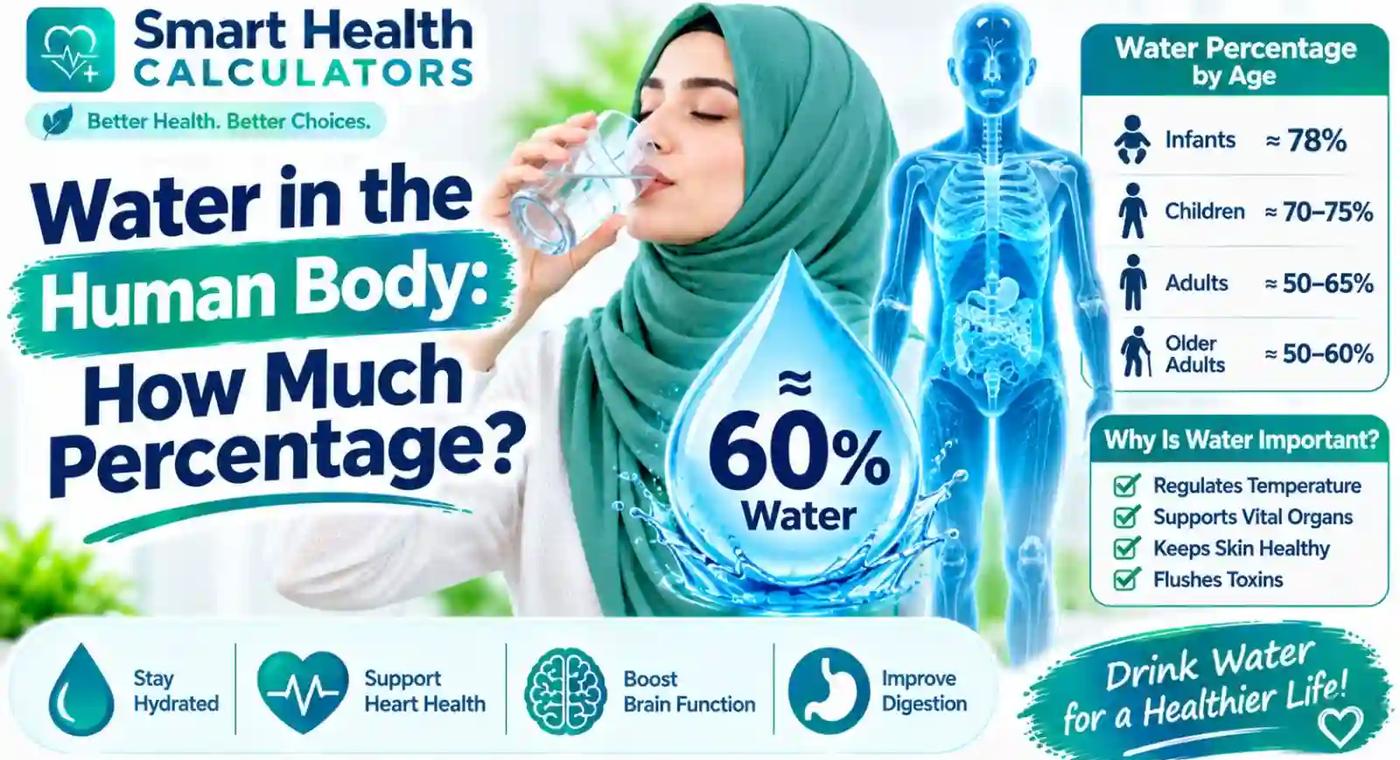
Water Percentage in the Human Body: Age, Sex & Organs
What percentage of the human body is water? See averages by age and sex, water in organs, how it’s measured, and why muscle holds more water than fat.
Water makes up roughly 50–60% of an adult's body weight. The exact figure depends on age, sex and body composition. The National Academies put the average at about 60%, with a normal spread of roughly 45–75% between people. Babies hold far more, close to three-quarters of their weight at birth. About two-thirds of your body water sits inside cells and about one-third sits outside them.
Figures were checked against the USGS, the National Academies and a peer-reviewed study. They are general reference values, not a diagnosis. Individual percentages vary.
- "60% water" is a useful average for adults, not a fixed number for everyone.
- Adult men typically carry a higher water percentage than adult women, mostly because of body composition.
- Water percentage falls from infancy through old age.
- Muscle holds far more water than fat, so lean people usually have a higher percentage.
- Body water percentage is not the same as how hydrated you are today.
You've probably heard that "the human body is 60% water." It's one of those facts everyone repeats and almost nobody checks. Is it true for you? For a toddler? For your grandmother? What about your brain or your bones?
The short version is that the number is real but slippery. It moves with age, sex and how much muscle you carry. This guide gives you the numbers, shows where they come from, and explains why they differ between sources. You'll also learn where the water actually sits in your body, how it's measured, and what your smart scale can and can't tell you.
What Percentage of the Human Body Is Water?
Two respected sources put adult body water in the same neighborhood, with slightly different framing:
- The USGS Water Science School says up to 60% of the adult human body is water, and gives about 60% for adult men and about 55% for adult women.
- The National Academies' Dietary Reference Intakes for Water report that total body water averages approximately 60% of body weight, with a range from about 45% to 75%.
Notice the words "up to" and "range." They matter. Sixty percent is a ceiling for many adults and a midpoint for the population. It is not a target you should hit.
The Short Version for Quick Reference
| Group | Typical total body water (% of body weight) |
|---|---|
| Newborn to 6 months | About 74% (range 64–84) |
| Adult men, 19–50 | About 59% (range 43–73) |
| Adult women, 19–50 | About 50% (range 41–60) |
| Men 51 and older | About 56% (range 47–67) |
| Women 51 and older | About 47% (range 39–57) |
Source: National Academies, Table 4-1 in the water chapter linked above. Different sources round differently, so you'll see slightly different numbers elsewhere.
How Does Body Water Percentage Change With Age?
Water percentage is highest at the start of life and drifts downward. This is one of the clearest patterns in the data.
Newborns and Infants
Babies are the wettest humans. The National Academies list a mean of about 74% for infants up to six months. The USGS cites about 78% at birth, falling to about 65% by one year. The two numbers differ because they use different studies and age cutoffs. Both agree on the story: infants hold roughly three-quarters of their weight as water, and it falls quickly during the first year.
Why so much? Infants have little fat-free tissue by adult standards, and their bodies are still building the tissues that later hold less water. If you want to see how this plays out in daily life, our guide to pregnancy water intake covers fluid needs before birth.
Children
By age one to twelve, the Academies' table shows a mean of about 60%, with a wide range of 49–75%. In a 2023 study published in Kidney Research and Clinical Practice, titled "Body water percentage from childhood to old age", researchers measured 545 people aged 3 to 98 using bioelectrical impedance. In the 3–10 group, males and females were similar, at about 62%.
Teenagers and Adults
This is where the sexes pull apart. The Academies note that sex differences in total body water don't appear until about age 12. After puberty, males hold a higher share. In the 2023 study, normal-weight males stayed fairly stable into adulthood, while females dropped to about 55% in the 11–20 group.
Older Adults
Water percentage falls again later in life. According to the Academies, women and older people have reduced total body water mainly because they have less fat-free mass and more body fat. In the 2023 study, normal-weight people of both sexes showed a decline after age 60, to about 57% in males and about 50% in females aged 61 and over.
One caution: these are group averages. A fit 70-year-old can have a higher water percentage than a sedentary 30-year-old.
Do Men Have More Body Water Than Women?
On average, yes. The USGS gives about 60% for men and about 55% for women. The Academies' adult table shows about 59% for men and about 50% for women aged 19–50.
The reason isn't that men "drink more." It's body composition. Women generally carry more body fat, and fat holds much less water than lean tissue. The USGS makes the same point: fat tissue has less water than lean tissue, so people with more fatty tissue have a lower proportion of water.
That is also why a woman and a man of identical weight can have different percentages without either being unhealthy. If you want a sense of where you sit on the body-fat side of that equation, try our body fat estimator or read the body fat percentage chart.
Why Does Muscle Hold More Water Than Fat?
This is the single most useful idea in the whole topic, so it's worth slowing down.
According to the National Academies, fat-free mass is approximately 70 to 75% water, while adipose tissue (body fat) is approximately 10 to 40% water. The Academies also note that the water fraction of adipose tissue falls as a person gets fatter. And they point out that high muscle glycogen stores raise the water content of fat-free tissue, which is one reason athletes tend to have relatively high total body water.
A Worked Example (Illustrative)
Take two people who both weigh 70 kg. We'll use round midpoint assumptions: fat-free mass at 73% water and fat tissue at 25% water.
- Person A has 56 kg of fat-free mass and 14 kg of fat. Water ≈ (56 × 0.73) + (14 × 0.25) ≈ 40.9 + 3.5 = about 44.4 L, or roughly 63% of body weight.
- Person B has 46 kg of fat-free mass and 24 kg of fat. Water ≈ (46 × 0.73) + (24 × 0.25) ≈ 33.6 + 6.0 = about 39.6 L, or roughly 57%.
Same scale weight, noticeably different water percentage. Neither person is "dehydrated." They simply carry different amounts of muscle and fat. This is an illustration with simplified inputs, not a measurement.
If you're changing your body composition, our posts on losing fat and gaining muscle and visceral vs subcutaneous fat go deeper. And if you're wondering why BMI alone misses this, see BMI vs body fat percentage.
Where Is the Water in Your Body?
Water isn't one big pool. Physiologists split it into two compartments.
Intracellular Fluid (Inside Cells)
The National Academies state that body water is distributed between the intracellular fluid (ICF) and the extracellular fluid (ECF), containing 65% and 35% of total body water respectively. So roughly two-thirds of your water is inside your cells.
Extracellular Fluid (Outside Cells)
The extracellular fluid is the roughly one-third that surrounds and serves your cells. It includes blood plasma (the liquid part of blood) and interstitial fluid (the fluid bathing the spaces between cells). Plasma carries nutrients and waste around the body. Interstitial fluid delivers them to the cells.
A Real-World Number
For a 70-kg man, the Academies describe about 42 liters of total body water. That splits into about 28 liters inside cells and about 14 liters outside them. Picture roughly four large water-cooler bottles' worth of water inside you, and most of it is locked inside your cells.
Why the Split Matters
When you lose fluid through sweat or illness, it doesn't leave evenly. Kidneys and hormones work constantly to keep the balance of water and dissolved salts (electrolytes) stable between the two compartments. This balancing act is called fluid homeostasis. If you train hard, our guide on electrolytes for weight training explains why salts matter as much as water.
Water Percentage in Different Organs
Whole-body figures hide a lot. Individual organs differ widely. The USGS lists these values, which it attributes to a 1945 study by Mitchell and colleagues:
| Organ or tissue | Water (%) |
|---|---|
| Lungs | About 83 |
| Muscles | 79 |
| Kidneys | 79 |
| Brain | 73 |
| Heart | 73 |
| Skin | 64 |
| Bones | 31 |
Two cautions before you quote these.
First, they describe individual organs, not the whole body. The brain at 73% does not mean the body is 73% water.
Second, they come from older research, and the numbers vary by method. The USGS lists muscle at 79%, while the Academies describe fat-free mass (which includes muscle and other lean tissue) at about 70–75%. Those aren't in conflict. They measure different things. Treat organ percentages as helpful approximations.
Yes, even bones contain water. At about 31%, they're the driest tissue on the list, but they're not dry.
Why Is the Human Body Made of So Much Water?
Water isn't filler. It does specific jobs. Based on the USGS list, water in the body:
- Builds cells. It's a basic building material and essential to every cell.
- Regulates temperature. Sweating and breathing release heat.
- Moves nutrients. It carries metabolized carbohydrates and proteins through the bloodstream.
- Removes waste. Much of it leaves through urine.
- Cushions. It protects the brain, spinal cord and, during pregnancy, the fetus.
- Lubricates. It forms saliva and cushions joints.
In physiology terms, that's metabolism, thermoregulation, nutrient transport and waste elimination, all running through a water-based system. This is why even mild disruptions in fluid balance can make you feel off. Our explainer on what hydration really means covers the day-to-day side.
How Is Total Body Water Measured or Calculated?
The Basic Formula
Total body water percentage is simple arithmetic. In the 2023 study above, researchers calculated it as total body water (in liters) divided by body weight (in kilograms), expressed as a percentage. If a person has 36 L of water and weighs 70 kg, that's roughly 51%. (Treat that as a worked example of the formula, not a typical reading.)
The hard part is finding the liters. That needs measurement.
Measurement Methods
- Bioelectrical impedance analysis (BIA). A small electrical current passes through the body, and the device estimates water from how much resistance it meets. The 2023 study used BIA. Clinics and many consumer scales use versions of it.
- Isotope dilution. Researchers give a harmless tracer, commonly a heavy form of water, and measure how much it dilutes in the body. It's a laboratory method that's generally considered more precise, though less practical.
Do Smart Scales Measure Body Water Correctly?
They give an estimate, and it can wander. Readings can shift with how recently you ate, drank, exercised or sweated, and different devices use different equations. A single reading is a rough guide. A trend measured under the same conditions (same time of day, same scale) is more useful than any one number.
Please don't treat a scale's water percentage as a diagnosis. It can't tell you whether you're healthy or dehydrated. If you have symptoms or concerns, a doctor can assess you properly.
Body Water Percentage vs Hydration Status vs Daily Water Intake
People mix these up constantly, so let's separate them.
| Concept | What it means | Changes how fast? |
|---|---|---|
| Body water percentage | Share of your body weight that is water | Slowly (age, composition) |
| Hydration status | Whether you have enough fluid right now | Hours to days |
| Daily water intake | How much you take in from drinks and food | Every day |
Your body water percentage can be perfectly normal on a day you're mildly dehydrated. And you can drink plenty of water without changing your underlying percentage much, because that is largely set by your composition.
How Much Water Does the Body Need Daily?
Recommendations differ by source and by person. The National Academies set an Adequate Intake for total water (drinks plus food) of about 3.7 L per day for young men and 2.7 L for young women aged 19–30. The USGS cites a lower figure, about 3 L for men and about 2.2 L for women, and notes that needs vary with age, gender and location. Part of your water comes from food, so these totals are not "glasses of water."
Treat all of these as general reference points, not prescriptions. Your own needs depend on your size, activity, health and climate. The water intake calculator gives a personalized estimate, and the daily water intake guide explains the reasoning.
What Can Change Your Body Water Percentage?
Body Composition and Weight
As covered above, more muscle tends to raise the percentage, and more fat tends to lower it. In the 2023 study, overweight participants had significantly lower total body water percentage than normal-weight participants of both sexes. If you're curious where you stand on weight and height, the BMI calculator and ideal weight calculator are quick starting points, and is BMI accurate? explains their limits.
Age and Sex
Already covered: infants highest, older adults lower, men higher than women on average.
Dehydration and Fluid Loss
Heavy sweating, vomiting, diarrhea, fever, or too little fluid can lower your body's water temporarily. This is a change in hydration status, not a permanent shift in your composition. Watch for early warning signs: our guide to the signs you're not drinking enough water lists them. Seek medical help for severe symptoms such as confusion, fainting, very little urine or inability to keep fluids down.
Too Much Water
You can also overdo it. Drinking very large amounts in a short time can dilute the body's sodium, a risk called hyponatremia. It's uncommon in everyday life but matters for endurance athletes. Read can you drink too much water? and water intake for athletes for context.
Climate and Activity
Hot weather and exercise raise how much fluid you lose and need to replace. They don't change your composition directly, but they change your day-to-day balance. Our posts on how climate affects water needs and how much water to drink in extreme heat are especially relevant if you live somewhere hot, such as much of South Asia or the Gulf. A note on regional claims: we haven't found a verified country-by-country dataset of body water percentages, so we don't give one. The physiology described here applies broadly, and local climate mainly affects how much you need to drink.
Is There an "Ideal" or "Healthy" Body Water Percentage?
There's no single healthy number. The sources above describe wide normal ranges. For example, the Academies' adult ranges run from the low 40s to the low 70s across individuals. A reading that falls within your age-and-sex reference range isn't a sign of anything wrong, and one slightly outside it isn't automatically a problem.
What matters more is the pattern and the context:
- A stable reading over time is generally reassuring.
- A sudden, unexplained change, especially alongside symptoms such as swelling, extreme thirst, dizziness or very dark urine, is worth discussing with a clinician.
Don't chase a target percentage. You can't "drink your way" to a higher body water percentage, because it mostly reflects composition.
Practical Tips: Use This Knowledge Well
- Track trends, not single readings. If you use a scale with a water reading, weigh at the same time under similar conditions.
- Think composition, not just weight. Building muscle supports a higher water percentage. Our full-body toning exercises are one place to begin.
- Spread fluids through the day. Steady sipping beats chugging. Before exercise, see how much water to drink before a workout.
- Count food and drinks. Total water includes what you eat. Some options support both hydration and heart health, as in our post on the best drinks for heart health.
- Adjust for heat and activity. Drink more when you sweat more.
- Ask a professional if something feels off. Persistent swelling, thirst or fatigue deserves a proper check.
If weight loss is your goal, hydration and weight loss explains what water can and can't do.
Why Choose Smart Health Calculators?
Health numbers are easy to misread. Why choose Smart Health Calculators? Because we try to show you the source behind a figure, flag where sources disagree and avoid pretending one number fits everyone. You'll find calculators for the practical questions this article raises, plus guides that explain the "why" in plain language. Browse our full range of health calculators if you'd like to see what's available.
Smart Health Calculators provides general education and estimates. It doesn't replace advice from a doctor or dietitian.
Frequently Asked Questions
What percentage of the human body is water?
Roughly 50–60% of an adult's body weight, with a normal range across individuals of about 45–75%. Newborns hold around three-quarters of their weight as water.
Is the human body really 60% water?
For many adults, it's a reasonable average, and the USGS says "up to 60%." But it isn't universal. Women, older adults and people with more body fat typically have lower percentages.
Do men have more water in their bodies than women?
On average, yes. The USGS gives about 60% for men and about 55% for women. The difference mostly reflects body composition, because fat holds less water than lean tissue.
Which organ contains the most water?
According to the USGS, the lungs, at about 83%. Muscles and kidneys follow at 79%, and the brain and heart sit at 73%.
How much water is inside human cells?
About two-thirds of your total body water. The National Academies state that intracellular fluid holds 65% of total body water and extracellular fluid holds 35%.
Is body water percentage the same as hydration level?
No. Body water percentage is how much of your weight is water, which changes slowly. Hydration status is whether you currently have enough fluid, which can change within hours.
Can I check my body water percentage at home?
You can estimate it with a body-composition scale that uses bioelectrical impedance. Treat the number as a rough estimate, since readings vary with meals, fluids and exercise. It isn't a medical diagnosis.
Conclusion:
The "60% water" line is a good starting point, but the real picture has more texture. Water makes up about half to three-fifths of an adult body, more in infants and less in older adults. Roughly two-thirds sits inside cells. Muscle is wet, fat is relatively dry, and that's why composition drives most of the differences between people. Your scale's water reading is a helpful estimate at best, and your body water percentage isn't the same as how hydrated you are today.
For a practical next step, work out how much you should be drinking with the water intake calculator, then compare your body composition with the body fat estimator. When you're ready for more, Explore Advanced Tools at Smart Health Calculators.
Medical Disclaimer
This article is for general education only. It is not medical advice, diagnosis, treatment, prescription guidance, or a replacement for professional healthcare. Speak with a qualified healthcare professional for personal medical concerns, symptoms, pregnancy concerns, mental health crisis, medication questions, or before making major health changes.